Free Trial Screen Free
Modulo

Science Journal for Kids

No reviews
Recommended Ages
Check the reading level for each article. Some articles have an upper and a lower reading levels.

4th - 12th grade

Science Journal for Kids takes real scientific research published by experts and rewrites it in a way that middle school and high school students can understand. Founded by scientists and educators who wanted to make cutting-edge research accessible, it has grown into a global resource used in classrooms in more than 100 countries. Each article is peer-reviewed for accuracy, paired with teacher resources, and available for free online. Families love that it helps kids practice reading science in a clear, engaging way while connecting to real-world issues. It’s an ideal fit for curious learners who enjoy science or need extra support understanding research articles, though it’s not designed for very young children. With its high-quality content and zero cost, parents say the value is unmatched.

Features
Literature BasedSelf-Paced

Great fit for upper-elementary through high school students who enjoy stories about real scientists, current research, and “how we know what we know,” and for families who like discussion-based science or want to add depth to BFSU or another spine.

Pros

Free, nonprofit resource that rewrites real peer‑reviewed science papers into kid-friendly articles, often with teacher resources, making it a powerful way to expose tweens and teens to authentic research and data interpretation; frequently recommended in secular homeschool lists as a go‑to for real-world science reading. 

Cons

Not a full science curriculum: there’s no overarching sequence, and reading level can be challenging for younger or reluctant readers; many articles still require guidance to unpack graphs and methods, so it works best when an adult is available to discuss and scaffold. 

All content is freely available, so government funding is not required to access it. Some publicly funded virtual schools and charters include it in their recommended resource lists or professional-development trainings.

FREE

Science Journal for Kids
$0.00 USD

Skills

What kids will learn

Science Journal for Kids Mission
The mission of Science Journal for Kids is to open up real scientific research to children and teens by translating current peer‑reviewed papers into kid‑friendly articles and lessons. Each adaptation keeps the core methods and findings intact while simplifying the language, adding diagrams, and providing videos, quizzes, and teacher guides. By letting students read what working scientists actually do—rather than just textbook summaries—the project aims to demystify science, strengthen data‑literacy skills, and inspire the next generation of researchers and informed citizens.

Science Journal for Kids Story

Science Journal for Kids was created in 2015 by science teacher Tanya Dimitrova, who came up with the idea while teaching high school in Texas. After watching her students struggle to make sense of a dense research paper she had assigned, she realized they needed a bridge between textbook science and real scientific literature. She began rewriting journal articles in accessible language and asking colleagues to help illustrate them, eventually turning the idea into a nonprofit online journal. Today Science Journal for Kids hosts hundreds of freely downloadable articles in multiple languages and collaborates with scientists around the world to adapt new studies every year.

About Modular Learning

FAQ: Additional Details about Science Journal for Kids

A typical session might involve printing an article or opening it on a tablet, then reading together about a real-world study on coral reefs, endangered animals, or renewable energy. You’ll hear new vocabulary, see colorful diagrams and photos, and perhaps move into a simple follow-up activity or discussion using the included comprehension questions and worksheets.

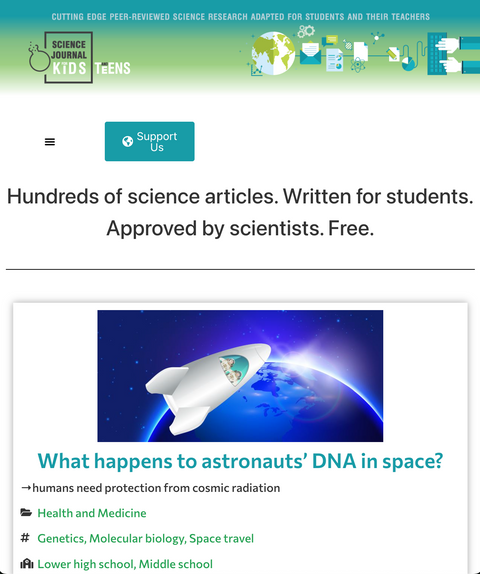
Science Journal for Kids (and Teens) is a free, nonprofit website that rewrites real peer-reviewed research into age-appropriate, illustrated articles for students. Parents and teachers search the database by topic or grade level, download PDF articles and teaching resources, and use them as living-textbook readings to support units in biology, ecology, climate science, and more.

Adult involvement is important: a parent or teacher usually introduces the article, helps unpack graphs and methods, and facilitates discussion about what the scientists did and what the results mean. Older teens may handle reading independently but still benefit from guided debriefs.

Students benefit from solid reading comprehension at the chosen level and some familiarity with basic scientific concepts; the site offers versions for different age bands so younger readers can still access the core ideas. No special technology beyond a PDF reader and printer (optional) is required.

Science Journal for Kids rewrites real scientific papers at kid‑friendly reading levels, which is great for gifted, 2e, and science‑obsessed learners who want “real science.” Articles can still be dense for dyslexic or ADHD students, so families may prefer reading aloud, annotating together, and focusing on diagrams.

Science Journal for Kids adapts real scientific papers into kid-friendly articles with clear diagrams and visuals, which can help some sensory-sensitive learners by making abstract environmental and climate topics more concrete and visually organized.

Great for older 2e learners who are conceptually strong but may read below “grade level” — articles adapt real research into more accessible language, and many come with visuals and questions you can tackle orally.

Because the resource is free, there is no purchasing or refund process; families can simply stop using any article or activity that doesn’t work for them and choose a different one.

Less suitable as a sole resource for early elementary, kids with very low reading stamina, or families looking for a plug-and-play video or lab-heavy program.

Alternatives and companions include Frontiers for Young Minds, NASA’s Climate Kids, and teacher-curated science news on sites like Newsela.

The site regularly publishes new kid-friendly research articles from across the sciences and continues to expand teacher resources such as slide decks, quizzes, and hands-on extensions. This makes it easy to keep content current with emerging science topics.

Choose one article every week or two, have your child highlight the research question, methods, and conclusion, then ask them to create a one-page infographic, comic, or short presentation to share what they learned.

Contact form

Meet Tanya

Tanya Dimitrova is the founder, executive director, and managing editor of Science Journal for Kids. Trained in environmental science and experienced as a classroom teacher at multiple grade levels, she is passionate about helping young people understand not just scientific facts but the process of research itself. Through Science Journal for Kids she leads a small international team that adapts studies from top journals into articles, videos, and lesson plans for classrooms everywhere. A fun fact: she has delivered TEDx talks about making science accessible and still loves fieldwork, from bee research to climate‑change studies.